A “CBRI certified” label does not identify a fire-resistance period, prove that the complete door assembly was tested, or confirm that the product suits your wall, opening and hardware schedule. By the end, you will be able to specify the evidence, compare testing routes, review a door-set submittal and accept installed metal fire doors against a Bangalore project’s fire strategy.
Key takeaways
- Request a traceable CBRI report or certificate before accepting certification.
- Compare the tested rating, door assembly, hardware, frame, and installation details.
- Specify rating, opening size, swing, hardware, and site conditions together.
- Record product identity, installation checks, and fire-door maintenance evidence.
What CBRI certification must prove before you accept it
CBRI certification is evidence from a Central Building Research Institute test report or certificate; it is not a fire rating by itself. For certified fire doors in Bangalore, request a traceable document before accepting the claim.
1. Record the certificate or report number, issue date, certificate holder, manufacturing location, test standard, furnace orientation, fire-resistance period and acceptance criteria.
2. Confirm whether the result proves integrity alone or integrity plus insulation. Check whether smoke leakage was tested separately; a fire-resistance result does not automatically establish smoke-control performance.
3. Match the evidence to the complete door-set: leaf, frame, hinges, lock or panic hardware, closer, vision panel, intumescent seals, fixing method and surrounding wall construction. The report should identify maximum opening dimensions, leaf count, frame profile, hardware limits and wall type.
4. Reject assumptions created by component labels. A certificate for one steel leaf does not automatically cover a double-leaf set, a larger opening, a glazed version or substituted hinges, locks, closers or panic devices.
5. Compare the delivered assembly with the tested construction, including seal size, clearances, anchoring and fire-stopping around the frame. A compliant leaf installed in the wrong wall or with missing seals does not provide the certified performance.
Treat “CBRI certified fire doors” as a compliance package: current report or certificate, identified construction, stated rating, approved hardware and installation limits, not as an unqualified marketing phrase. If any item is missing, ask the supplier to resolve the gap before approval.
How to compare CBRI evidence with other fire-door test routes
Require one named evidence route, not the words “fire rated.” A CBRI test report records performance from a Central Building Research Institute test; it is not a rating or a substitute for IS 3614, IS 17518, EN 1634-1 or UL 10C. The tender must state the standard, approved assessment route, duration and acceptance criteria.
| Route | What it establishes | What to verify |
|---|---|---|
| CBRI report or certificate | Laboratory evidence for the tested doorset | Named test standard, rating and scope; CBRI certified fire doors are not automatically interchangeable with another route |
| IS 3614 | Indian fire-door test or product basis named by the project | Exact edition, acceptance criteria and whether the evidence covers the proposed assembly |
| IS 17518 | Indian fire-resisting doorset route | Report scope, classification and installation limitations |
| EN 1634-1 | European fire-resistance test for doorsets and shutters | Integrity (E), insulation (I), rating, specimen configuration and any required smoke evidence |
| UL 10C | North American positive-pressure fire test for door assemblies | Listed assembly, pressure condition, hardware and rating; do not treat it as an Indian approval by default |
State the required period as 30, 60, 90, 120 or 180 minutes, then specify whether acceptance means integrity alone, integrity plus insulation, or separate smoke-leakage performance. Ask for evidence covering:
- Single or double leaves, glazed panels, maximum tested width and height, frame and wall type.
- Leaf, frame, hardware, seals, fixing method and clearances in the proposed configuration.
- The certificate or report number, issue date, manufacturer and manufacturing location.
“Fire resistant” and “fire rated” establish neither route nor compliance. Specify the evidence route instead of accepting a generic claim about a fire rated metal door.
What a tested steel fire door assembly includes
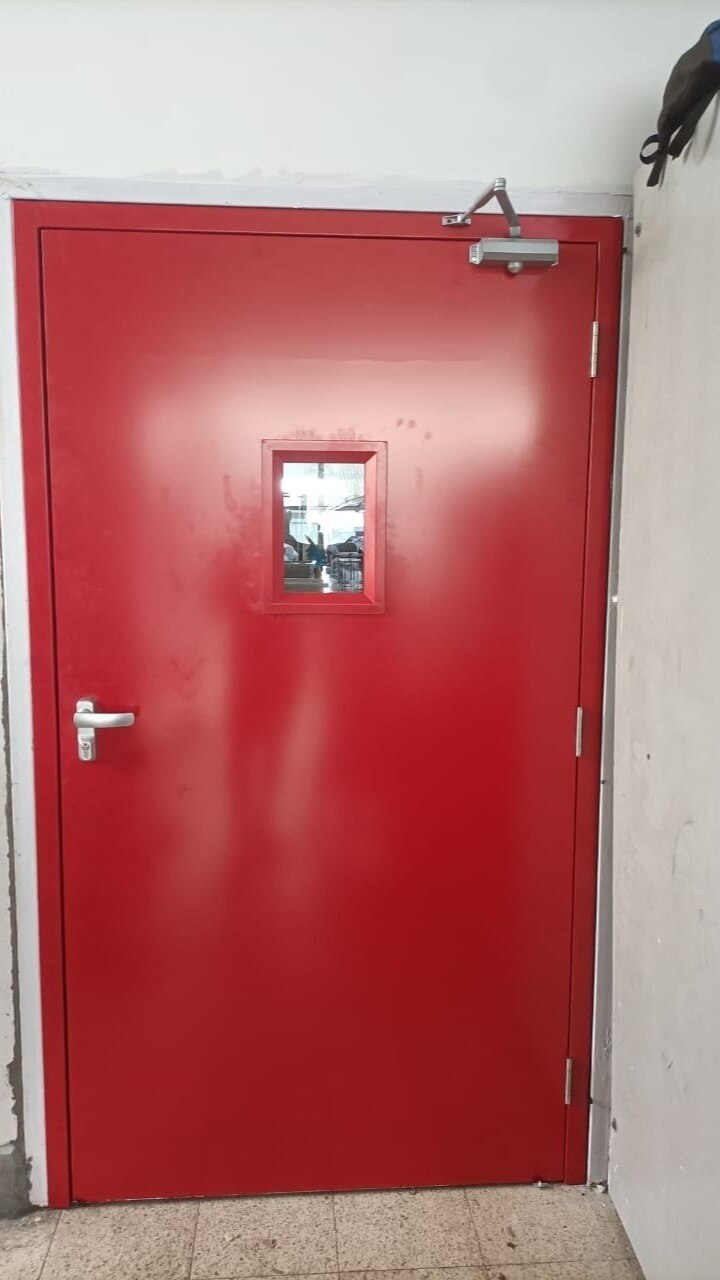
Request a component schedule and installation drawing before approving a steel fire door manufacturer’s submittal. A fire rated metal door is a tested assembly, not a steel leaf: steel grade and facing thickness, leaf thickness, core type and density, edge construction, frame profile and frame thickness must match the tested or assessed construction.
1. Check the leaf schedule for the steel grade, facing thickness, leaf thickness, core density, edge detail, vision-panel type and maximum opening size. Record intumescent seal and smoke-seal dimensions, plus the threshold and drop-seal arrangement.
2. Check the hardware schedule for hinges, mortice lock, latch, closer, coordinator, panic bar and any hold-open device. Each item must be within the evidence; a matching material name does not prove a rating.
3. Check the frame detail for anchors, fixing centres, packing and fire-stopping. Blockwork, lightweight partitions and shaft walls need the specific fixing and tested fire-stop arrangement; an adequately rated leaf in a poorly sealed opening is not a compliant door-set.
4. Check clearances, meeting stiles, undercut, latch engagement and threshold against the tested drawings. An enlarged vision-panel opening, untested louvre, unapproved hardware drilling, removed seal or post-delivery welding can invalidate the evidence and needs written approval or a new assessment.
5. Check hold-open control. An electromagnetic unit must release when the fire alarm activates; a magnetic wedge is not a controlled substitute. Record every deviation before installation, not after handover.
How to choose the door type, rating and opening for a Bangalore project
Choose the opening to match the fire strategy, occupancy and location—not the product label. A fire rated metal door for a corridor, stair enclosure or service room is a personnel door; a fire-exit door also requires escape-compatible swing, hardware and clear width.
A shaft door, shutter, sliding fire door and large equipment or roller opening require evidence for their own construction and operation.
| Opening type | Correct evidence | Common mistake |
|---|---|---|
| Personnel door | Tested leaf, frame, hardware, seals and wall assembly | Using a single-leaf result for a double-leaf or larger door |
| Shutter or roller opening | Test or assessment covering the shutter, guides, curtain, operator and opening size | Relying on a personnel-door certificate |
| Sliding fire door | Evidence covering track, carriage, seals, closure and hold-open release | Treating it as a hinged door |
Select 30, 60, 90, 120 or 180 minutes only after the fire strategy, approved drawings and authority documents establish the period. The documents should identify whether the opening protects a fire compartment, escape route, stair enclosure, shaft, service room or equipment room, and whether the result requires integrity alone or integrity plus insulation.
Check the required clear opening, structural opening width and height, single or double leaves, swing direction and escape-route width. Specify accessible lever hardware or panic hardware where occupants must exit, plus self-closing and positive latching; a door that cannot latch after release is not performing as tested.
Fire rating does not automatically provide smoke control, acoustic separation, weather resistance, security or corrosion protection. Specify and evidence each separately, or include it in the same tested configuration. “Certified fire doors in Bangalore” and “CBRI certified fire doors metal door for projects in Bangalore” are not substitutes for that scope.
How to review, install and record certified fire doors on site
Start with the evidence package, not the door label. For certified fire doors in Bangalore, require a current CBRI certificate or test report showing the certificate holder, manufacturing location, report validity, exact model or construction, rating, test standard, maximum tested dimensions and scope.
Ask for the hardware schedule, wall limitations, seal specification, installation drawings and traceability from each delivered door set to that evidence. A steel fire door manufacturer should provide these documents before approval; Rock Miller Doors can be asked for evidence in this form rather than a “CBRI certified” claim.
Check that the proposed frame, hardware, number of leaves and opening size fall within the report. Confirm the certificate covers the required rating, not merely a product category, and identifies whether the test covers integrity alone or integrity plus insulation. Use this comparison when reviewing submittals:
| Evidence item | Accept when | Reject when |
|---|---|---|
| Certificate or report | Current, numbered and names the construction | Generic letter or expired document |
| Dimensions and leaves | Proposed size and single/double-leaf arrangement are within scope | Opening is larger or configuration differs |
| Frame, wall and hardware | Details match tested fixing, wall and hardware limits | Substitutions are unexplained |
At installation, record opening identification, rating, leaf count, dimensions, frame and wall type, hardware, seals, clearances and photographs. Test closer operation, latch engagement, panic release and controlled hold-open release. Record missing seals, excessive undercuts, non-latching leaves, damaged frames and propped-open doors.
A compliant leaf in an inadequately fire-stopped opening is not a compliant installation; the final schedule supports inspection, handover and maintenance.
Frequently asked questions
What must CBRI certification prove before you accept it?
Request a traceable CBRI test report or certificate that identifies the tested door assembly, fire-resistance rating, specimen details, test standard, document number, and validity or scope information. Match those details to the proposed door rather than accepting a label alone.
How should you compare CBRI evidence with other fire-door test routes?
Compare the issuing laboratory, test standard, fire-resistance rating, specimen construction, frame, hardware, and field-of-application rules. Evidence is comparable only when the tested assembly and rating basis address the same project requirement.
What does a tested steel fire door assembly include?
Review the door leaf, frame, hinges, locks, closers, seals, glazing, fixings, and installation method. A steel fire door rating applies to the tested assembly, not automatically to an individual metal leaf.
How do you choose a fire-door type, rating, and opening for a Bangalore project?
Start with the opening’s required fire rating, wall construction, traffic, environment, clear width, height, swing direction, access control, and smoke-control needs. Select a door and frame combination whose documented test scope covers those conditions.
What should you review, install, and record on site?
Check delivered labels and documents, inspect the frame and leaf, install the specified hardware and seals, verify clearances and self-closing action, and record product identity, installation checks, defects, and maintenance actions.