A CBRI reference alone does not prove that every shaft door offered under the same product name will protect a rated opening. You will be able to compare the tested doorset, wall construction, fire criteria, hardware and installation evidence before approving a shaft-door specification or purchase.
Key takeaways
- Treat the CBRI document as evidence for one tested doorset configuration.
- Compare the fire rating, test standard and shaft-door function before ordering.
- Match the tested doorset with the shaft wall, hardware and project details.
- Inspect labels, gaps, hardware and installation records after fitting.
What a CBRI report actually proves about a shaft door
A CBRI document proves only what CSIR-CBRI tested or certified: a stated doorset in a stated configuration. It is not blanket approval for every size, wall, hardware combination or installation condition, and it is not automatically a BIS licence. A manufacturer claim or logo on a datasheet proves nothing without traceable evidence.
Request these items before accepting a shaft door:
- The complete CBRI report or certificate, including report number, issue date, revision or validity date, test standard, fire-resistance period and pass criteria.
- The tested specimen description: leaf construction, frame profile, tested dimensions, clear opening, wall construction, fixing method and exposure direction.
- The complete hardware schedule, naming hinges, latch, closer, intumescent seals, vision panel and access-control hardware. Confirm that the report covers the complete assembly, not only the leaf.
- Installation drawings, permitted dimensional or hardware deviations, fixing details and the manufacturer’s inspection and maintenance instructions.
- Traceability documents linking the delivered leaf and frame to the tested design, including batch or identification records.
Check the door’s function separately. A service-shaft access door is not automatically equivalent to a lift landing door; request evidence against the applicable lift code and the lift-door fire-resistance requirement. A door held open by a wedge, or one whose latch fails to engage, cannot reproduce tested behaviour.
For cbri certified fire doors in hyderabad, obtain architect, fire-consultant and Telangana fire-authority acceptance before procurement.
Compare the rating, standard and door function before choosing
Do not select a 120-minute door by habit. Take the required period from the approved fire strategy, National Building Code provisions, local fire-authority conditions and the shaft enclosure’s rating. Specify both integrity and insulation: integrity limits flame and hot-gas passage, while insulation limits heat transfer.
| Door type | Primary function | What to compare |
|---|---|---|
| Shaft access door | Closes a service, riser or inspection opening | Match the shaft wall, opening and required period; verify the complete tested doorset under IS 3614 or IS 16096 |
| Corridor or escape door | Protects a route used by occupants | Confirm escape hardware, swing, clear width and the tested fire-and-smoke performance; do not substitute a small access door |
| Lift landing door | Separates the lift shaft from each floor | Check the applicable lift code and lift-door fire-resistance evidence; a generic CBRI-tested steel door is not equivalent |
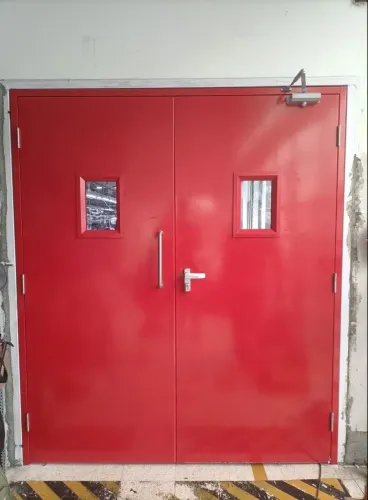
A shaft door’s smaller size or unusual swing does not make its rating interchangeable with a corridor door. The test must cover the frame, hinges, latch, closer, seals and access-control hardware supplied with the assembly, not just the leaf.
Ask any fire door supplier to identify the test basis, tested rating, wall construction and permitted dimensions in writing. A manufacturer or reseller offering fire rated shaft doors without traceability to that tested construction is offering a resemblance, not proof.
Compare the report details with the project specification before accepting a 60-, 90- or 120-minute model.
Match the tested doorset to the shaft wall and project variation
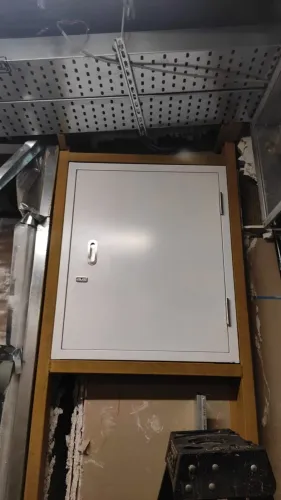
Confirm applicability by matching the complete tested doorset—not just the leaf—to your shaft opening. Compare the CBRI report’s specimen with the Hyderabad drawing for wall build-up, frame depth, fixing method, clear opening, leaf size and hardware.
Request these records before approving the shop drawing:
- The report or certificate number, revision date and tested fire-resistance period.
- Tested wall construction, including masonry, concrete or shaft-board thickness and the frame-to-wall anchorage.
- Door leaf height, width, thickness, construction and edge protection, plus frame profile and tolerances.
- Hardware schedule covering hinges, latch, closer, seals, threshold and any access-control device.
- Installation drawings showing fixing centres, packers, frame gaps and permitted dimensional deviations.
- Written technical justification for any transom, louvre, glazed panel, concealed hinge or electromagnetic hold-open arrangement not shown in the report.
A taller or wider leaf, deeper frame or different shaft wall is a design change, not a harmless substitution. Obtain written coverage from the test holder or an engineer before ordering metal shaft doors in Hyderabad, and verify that the installed frame preserves the required clear shaft-access opening.
Check the interfaces too. Cable trays, pipes, ducts, door-frame gaps and thresholds need compatible fire-stopping; a tested door cannot protect an opening weakened by unsealed penetrations. Trace the delivered leaf, frame and hardware to the approved schedule, then record the actual opening dimensions before fabrication.
Inspect the installed assembly, not just the certificate
A compliant-looking leaf is not enough: inspect the frame, hardware, seals, fixings and surrounding wall as one tested doorset. Compare what you find with the CBRI report, approved installation drawing and hardware schedule. A steel door fitted with untested hardware or an unsuitable frame is not equivalent to the tested assembly.
- Measure the leaf, frame, threshold and opening against the tested dimensions. An enlarged opening packed with unapproved materials changes the fire path.
- Check that the frame is square, fully supported and anchored into the tested shaft wall with the specified fasteners and spacing. Loose anchors or gaps around the frame are immediate defects.
- Examine intumescent strips and smoke seals for continuity, correct size, firm seating and paint-free contact. Missing, painted-over or damaged seals can let fire and smoke pass around the leaf.
- Operate the hinges, latch and closer. The door must close fully from any normal opening and engage the latch without being pushed; a wedge, hook or disabled closer defeats the tested function.
- Confirm that the installed lock, access-control device, vision panel and threshold match the approved schedule. A card reader, magnetic hold-open or replacement glass can invalidate the configuration.
- Look for corrosion, impact damage, drilled holes and warped leaf edges. Record each defect with photographs and its location.
Keep the shaft door unobstructed and inspect it after every hardware or wall-finish alteration. Repair with the specified components, not general-purpose sealant or replacement hardware chosen for convenience. Recheck the closing action after maintenance.
What to demand from a Hyderabad manufacturer or supplier
Reject any quote that offers a “fire-rated” leaf without proving who owns or controls the tested doorset design. A fire shaft door manufacturer in Hyderabad should trace each delivered leaf and frame to a CBRI report or certificate, not merely display a logo or marketing datasheet.
A reseller must identify the original manufacturer and provide the same evidence.
1. Request the complete CBRI report or certificate, including report number, issue or revision date, fire-resistance period, exposure direction, tested dimensions, wall construction and test basis.
2. Match the report to the quoted assembly. Check the leaf, frame, hinges, latch, closer, seals, anchors, vision panel and access-control hardware against the tested hardware schedule. Record every permitted deviation.
3. Demand installation drawings showing frame fixing, shaft-wall interface, clear opening, thresholds and tolerances, plus inspection and maintenance instructions. Obtain written confirmation that your opening dimensions and wall build-up fall within the tested scope.
4. Separate a lift landing door from an ordinary service-shaft door. Ask for evidence under the applicable lift code and for the lift-door assembly; a generic CBRI-tested steel door is not equivalent.
5. Submit the evidence to the architect, fire consultant and lift consultant before ordering. Confirm Telangana fire-authority acceptance for location, signage, smoke control and access requirements.
A fire rated door manufacturer in hyderabad should also state whether it manufactures the tested design or supplies another party’s product. Rock Miller Doors is worth evaluating on that specific question: request configuration-level evidence, not a catalogue description.
A CBRI report covers its stated specimen, not every size or installation, and is not automatically a BIS licence.
Related products
 | Fire Door Fire rated Shaft Doors / Fire Shaft Door RM Shaft Doors are an excellent example of our organization's Premum-quality results. View product → |
 | Fire Door Fire prevention is our top priority for every building designer or architect. View product → |
Frequently asked questions
What does a CBRI report prove about a shaft door?
It proves only what CSIR-CBRI tested or certified: a stated doorset in a stated configuration. It does not automatically approve every size, wall, hardware combination or installation condition, and it is not automatically a BIS licence.
How should you compare fire-rated shaft doors?
Compare the stated fire rating, test standard and door function. Confirm that the evidence covers the shaft application rather than treating a manufacturer claim or logo as certification.
Why must the shaft wall match the tested doorset?
The wall construction, opening size, hardware and installation details affect the tested assembly. Ask the supplier to identify how the proposed project variation relates to the tested configuration.
What should you inspect after a shaft door is installed?
Inspect the complete assembly, including the certification or test identification, door label, frame, hardware, clearances, seals, closing action and installation records.
Related product
 | Fire Door Fire Doors with Door Fittings View product → |