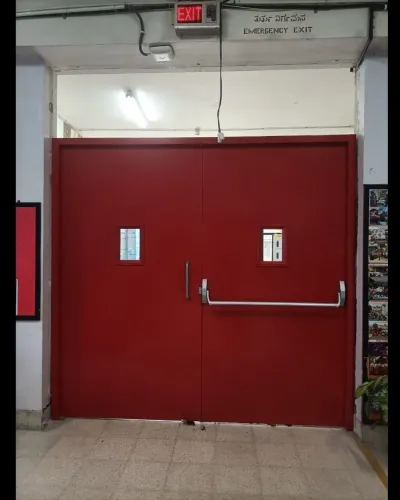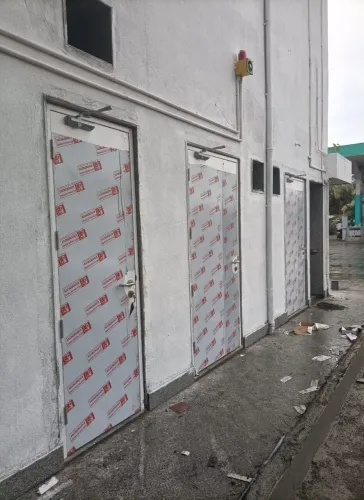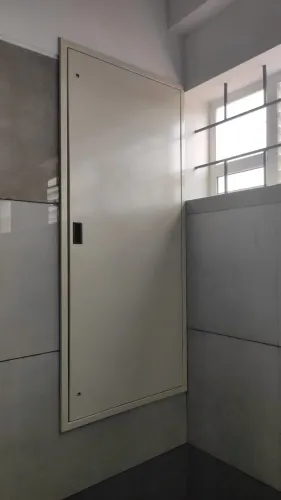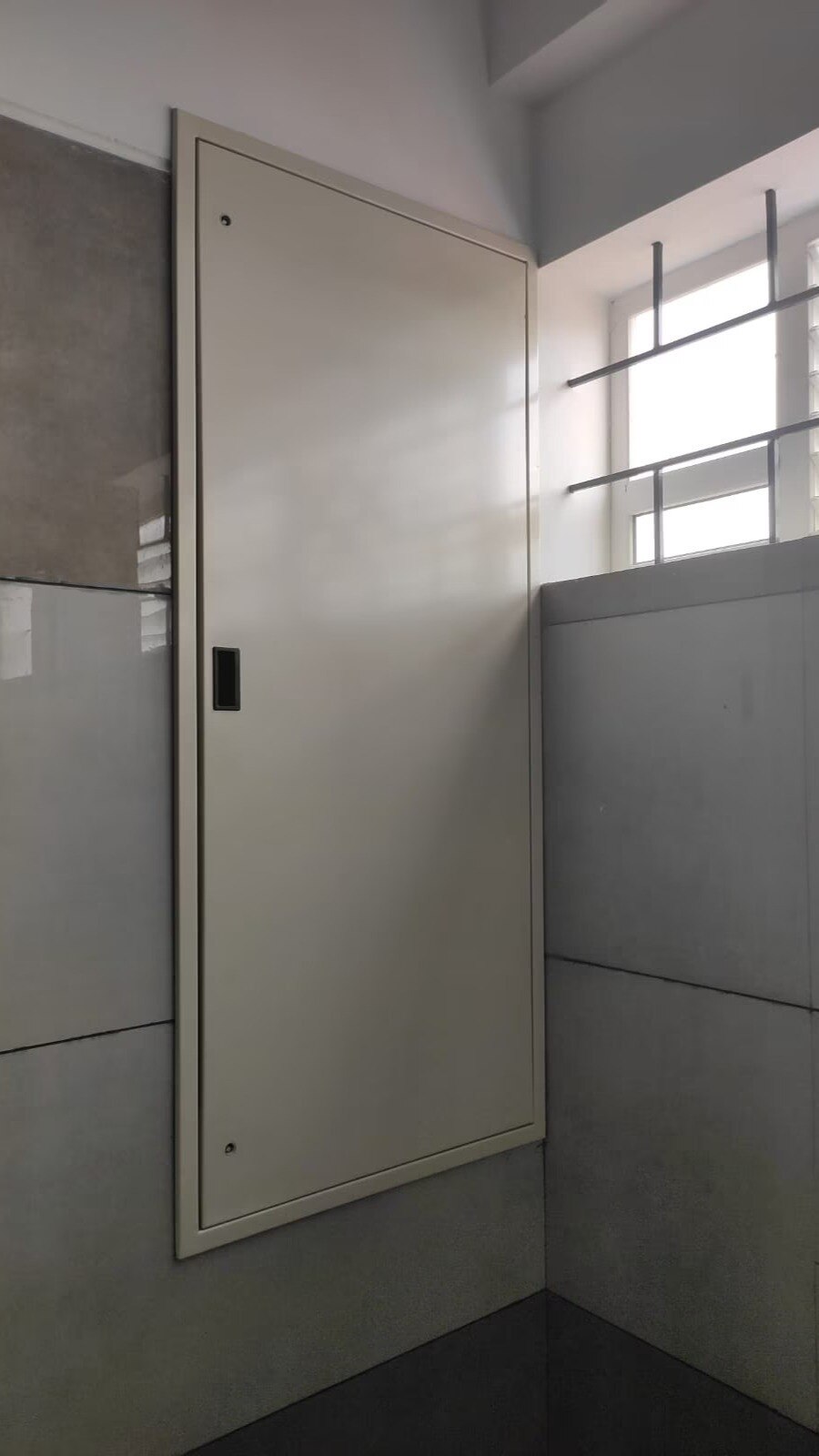
An unprotected riser can carry flame, smoke and heat between production rooms, laboratories, storage areas and service floors, defeating otherwise sound compartmentation. By the end, you will be able to match a shaft opening with the correct door type, verify a complete certified assembly and check whether it suits cleanroom pressure, hygiene and maintenance demands.
Key takeaways
- Protect shafts where they cross rated walls or floors.
- Use a tested, complete door-and-frame assembly—not an uncertified door leaf.
- Specify smooth, cleanable finishes and sealed interfaces for cleanrooms.
- Record inspections, repairs, and hardware changes after installation.
What a shaft door protects inside a pharmaceutical facility
Vertical service shafts, risers, utility chases and floor-to-floor penetrations need protection where they pass through compartment walls or rated floors. They carry ducts, cable trays, pipes and waste lines between production rooms, laboratories, storage areas and plant spaces.
A fire rated shaft doors assembly closes the maintenance opening so one compartment does not become a route into every level.
| Opening | How fire and smoke bypass | Protection needed |
|---|---|---|
| Service riser | Gaps around cables, pipes or ducts connect multiple floors | A rated shaft door and sealed penetrations |
| Utility chase | Hot gases rise through an open or poorly sealed chase | A rated closure at each compartment boundary |
| Floor-to-floor access opening | Smoke moves through the shaft before occupants see flames | A rated assembly with controlled perimeter leakage |
Fire travels upward by buoyancy, while HVAC pressure differences push smoke through door gaps, frames, guides and unsealed penetrations. That movement can defeat otherwise separated sterile processing, packaging, laboratory and storage zones; a fire-rated leaf alone does not stop it.
The listed assembly must include the leaf, frame, hardware, anchorage and any glazing, installed under its tested conditions.
“Pharmaceutical fire doors” is not a universal regulatory category. Pharmaceutical suitability comes from the facility’s compartmentation strategy, cleaning requirements and smoke-control design. Confirm whether the opening is access-only, because a shaft door carrying a fire label is not automatically a personnel exit door.
When a shaft opening needs a rated door rather than a standard fire door
Specify fire rated shaft doors when the opening serves a vertical shaft or riser and must preserve the fire-resistance boundary, yet still requires routine maintenance access. Do not treat the label as permission for personnel egress; verify locking, release and access provisions against the adopted building and fire codes.
| Option | What it provides | When it applies |
|---|---|---|
| Standard fire door | Hinged door assembly for a protected room or corridor opening | The opening is a conventional doorway, not a constrained shaft access point |
| Fire shutter | Vertically or horizontally closing barrier, often suited to larger openings | Clearance, operation and listing match the shaft geometry |
| Fire-rated access panel | Small, infrequently used service opening | The opening is limited to hand or tool access |
| Fire-rated hatch | Larger floor, ceiling or wall access opening | Equipment or maintenance movement requires a hatch format |
Determine the rating from the shaft enclosure’s fire-resistance rating, construction and location, then check the opening-protective table in the adopted building code. Confirm the requirements with the authority having jurisdiction and the building’s fire strategy. A 90-minute door is not automatically correct for a two-hour shaft wall.
Specify the complete listed assembly, including the frame, hardware, glazing, anchorage and installation conditions, rather than relying on the leaf’s nominal rating. Check temperature-rise, smoke-leakage and air-leakage requirements separately. If fire alarm release or access control is connected, document fail-safe operation, power-loss behaviour and acceptance testing.
What certification proves the complete shaft-door assembly
A valid certification covers the complete listed assembly, not merely a door leaf with a fire-resistance number. Request the laboratory test report or certification listing that identifies the leaf, frame, hinges, closer, latch, seals, glazing, glazing beads, anchorage and permitted installation conditions as one tested configuration.
| Evidence | What it must identify | What it proves |
|---|---|---|
| Fire-endurance listing | Standard used, such as NFPA 252, UL 10C or EN 1634-1; rating period; door, frame and hardware configuration | The assembly achieved the stated fire classification under that test method |
| Smoke-leakage report | UL 1784 or the jurisdiction’s named smoke-test standard, including pressure and leakage limit | The assembly has a separate smoke-control performance claim; fire endurance alone does not prove smoke tightness |
| Classification or label | Listing agency, model or series, rating, temperature-rise value where applicable, glazing limits and compatible hardware | The installed product matches the certified configuration |
| Installation instructions | Wall construction, frame anchorage, fasteners, clearances, support, seals, threshold and permitted field modifications | The tested conditions can be reproduced at the shaft opening |
A fire door supplier should show that any vision panel, access-control lock, electromagnetic holder, hinge, intumescent seal or smoke gasket appears in the listing. Drilling the frame, replacing hardware or adding unlisted glazing can void the certification.
Check the classification against the project’s required fire rating and smoke requirement. A temperature-rise rating is a separate value, important where people work near the opening. Washdown chemicals, humidity and disinfectants also belong in the approved product and installation record, not in an afterthought.
How cleanroom conditions change the shaft-door specification
A cleanroom shaft door must be specified as part of the contamination-control system, not selected from its fire label alone. Pharmaceutical fire doors need exposed faces that are smooth, non-porous and free of ledges, exposed fasteners and dirt traps; stainless steel cladding alone proves neither cleanability nor fire compliance.
Evaluate the door assembly against these conditions:
- Use corrosion-resistant steel, coatings, hinges and hardware where hydrogen peroxide vapour, hydrogen peroxide wipes or peracetic acid solutions contact the surfaces.
- Obtain chemical-compatibility data for the exact seal, gasket, adhesive and finish; a swollen gasket can stop the door from closing or destroy its smoke seal.
- Protect seals from carts, cleaning tools and shaft-edge damage, and specify thresholds, guides and sills that can be wiped without retaining residue.
- Coordinate perimeter gaps and bottom clearances with the HVAC pressure cascade; leakage at the frame or sill can destabilise room pressure.
- State the particle-control acceptance method, such as visual inspection, particle counting or recovery testing, in the qualification protocol.
- Specify the required smoke-leakage limit and test pressure when smoke migration matters.
UL 1784 measures air leakage from a door assembly under specified pressure conditions. It does not certify cleanroom suitability, chemical resistance, particle control or microbial-control performance.
Fire endurance and smoke control are separate claims. Require certified fire doors with a listed smoke-leakage assembly or smoke gasketing when the fire strategy demands it, then retain material certificates, cleaning-agent compatibility data and installation qualification records.
How to keep the rated opening compliant after installation
Keep the listed assembly intact from anchorage through inspection, or the opening can lose its fire and smoke performance even when the leaf carries a fire label. The fire door supplier must provide the complete listing, frame, hardware schedule, glazing limits, anchors and installation instructions.
1. Install only the listed frame, fasteners, hinges, closer, latch and seals. Do not drill the leaf for a card reader, add a vision panel, substitute hinges or remove intumescent material without written listing approval. Pack perimeter gaps exactly as the listing requires.
2. Integrate access control into the tested release sequence. Confirm what happens on fire-alarm activation, smoke-detector activation, power loss and communication failure. The arrangement must provide the code-required release while returning the fire rated shaft doors to their protective position; an access lock cannot be treated as an independent add-on.
3. Prove that the door closes fully from every normal opening position and engages its latch without assistance. Do not wedge it open for material movement. If smoke control is specified, verify the listed smoke gasketing and leakage performance at the stated pressure, because fire endurance alone does not prove smoke control.
4. Record commissioning results, including alarm release, power-loss behavior, closing speed, latch engagement and seal condition. Train operators not to defeat closers or hold-open devices.
5. Inspect and maintain the assembly under NFPA 80 and the adopted local code. Check for damaged seals, loose hardware, corrosion, frame movement, blocked clearance and failed latching, then document corrective work. Rock Miller Doors can help a facility match replacement parts to the original listing rather than accepting an unlisted substitute.
Related products
 | Fire Door Fire rated Shaft Doors / Fire Shaft Door RM Shaft Doors are an excellent example of our organization's Premum-quality results. View product → |
 | Fire Door Fire prevention is our top priority for every building designer or architect. View product → |
Frequently asked questions
What does a shaft door protect inside a pharmaceutical facility?
It closes vertical service shafts carrying ducts, cable trays, pipes, and waste lines between production, laboratory, storage, and plant areas.
When does a shaft opening need a rated door?
Use a rated shaft door when the opening passes through a fire-rated compartment wall or rated floor and the opening must maintain that barrier.
What certification proves a complete shaft-door assembly?
Request test or listing documentation covering the complete assembly: door leaf, frame, hinges, latch, closer, seals, and any access hardware.
How do cleanroom conditions change the shaft-door specification?
Specify smooth, non-shedding, corrosion-resistant, cleanable surfaces, sealed gaps, compatible gaskets, and hardware that will not compromise pressure control or hygiene.
How do you keep a rated shaft opening compliant after installation?
Keep the approved installation details, inspect the door and seals, test self-closing and latching, and document every repair or hardware change.
Related product
 | Fire Door Fire Exit Doors / Emergency Exit Door Rock Miller Doors are designed to protect lives in the event of a fire-related disaster for up to two hours. View product → |