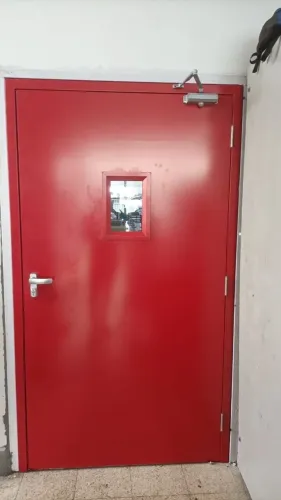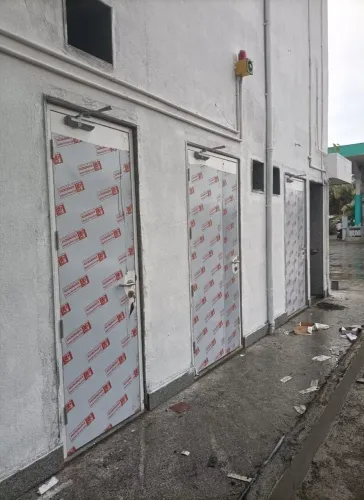
Replacing an industrial door closer is not a matter of choosing the strongest-looking unit. You need to match the replacement to the door’s size, mass, hinges, frame, traffic, wind exposure, fire-door evidence and escape hardware; by the end, you can compare options and prepare a specification that a supplier can verify.
Key takeaways
- Match closer size to door leaf width, mass, wind pressure and latch resistance.
- Record opening force, closing time and latch action before choosing a replacement.
- Request fire-test evidence covering the complete door, closer and hardware assembly.
- Give suppliers door dimensions, traffic conditions, fixing pattern and fire-door documentation.
Which replacement closer suits your industrial door?
Compare the door type and operating conditions before comparing brands. Record traffic frequency, opening force, required closing force, latch resistance and wind pressure; a “heavy-duty” label does not describe these loads.
| Option | Best fit | Main limitation |
|---|---|---|
| Overhead surface-mounted closer | Many hinged industrial doors; accessible adjustment and replacement | Can lack force on very large or wind-exposed leaves |
| Concealed closer | Clean appearance or protected hardware | Requires compatible frame, door section and mounting depth |
| Floor spring | Two-way movement where the floor and threshold accept the body | Needs a suitable pocket, spindle position and drainage protection |
| Spring hinge | Light, low-traffic leaves | Unsuitable for large doors requiring dependable latching against seals or wind |
| Electromagnetic hold-open | Fire doors held open under an approved alarm or detection release arrangement | It is not a closer; never use a wedge or ordinary non-releasing stay |
| Powered operator | Frequent traffic, accessibility needs or heavy leaves | Adds controls, sensors, commissioning, backup-power decisions and maintenance |
Sliding fire doors, high-speed doors, very large leaves and doors under substantial wind pressure may need dedicated self-closing equipment rather than an ordinary overhead unit. Check whether the door is single-leaf, rebated pair or unequal pair; paired leaves may need a coordinator, selector or integrated sequencing arrangement to latch correctly.
Give a door closer supplier in Chennai the leaf width and mass, opening angle, hinge condition, mounting side, traffic level and wind exposure. Request the tested power range, maximum leaf size, arm type, cycle rating, finish and fire evidence for the complete assembly—not merely a brand name.
How do EN 1154 sizes and site measurements determine the replacement?
1. Start with the door leaf width, thickness and approximate mass. Record the frame face width, hinge position, clearance above the door, mounting surface available on the pull and push sides, opening angle and existing mounting-hole pattern.
2. Use EN 1154 sizes as selection guidance, not as permission to ignore tested mounting geometry:
| Size | Approximate maximum width | Approximate mass |
|---|---|---|
| 2 | 850 mm | 40 kg |
| 3 | 950 mm | 60 kg |
| 4 | 1,100 mm | 80 kg |
| 5 | 1,250 mm | 100 kg |
| 6 | 1,400 mm | 120 kg |
| 7 | 1,600 mm | 160 kg |
3. Select a higher power size when wind pressure, thick seals, latch resistance or frequent traffic increases closing load. A parallel arm usually provides less leverage than a regular arm, while a narrow frame or deep reveal can reduce force further. Confirm the manufacturer approves the actual mounting geometry.
4. Inspect the door set before increasing power. Check butt hinges or offset pivots, alignment, frame distortion, leaf clearances, seals and latch friction. Excessive power can make opening unsafe, wear hardware and still leave a distorted door short of the latch.
5. Treat adjustable closing and latching valves as fine controls, not a cure for incorrect sizing or poor alignment. Give an industrial door closer supplier in Chennai the measurements, opening angle, hinge condition, closing requirement and wind exposure instead of requesting only a “heavy-duty” closer.
What evidence is required for a fire-door closer replacement?
A fire door closer in Chennai needs evidence for the complete door assembly, not only a product brochure claiming “fire rated.” Request documents that identify the exact door construction, frame, leaf size, hinge arrangement, mounting position, closer model and maximum permitted door size.
1. Check EN 1154 evidence for the mechanical closer. This standard covers controlled door-closing devices and their power classification from size 1 to 7. Confirm that the proposed mounting geometry and door dimensions match the manufacturer’s tested limits.
2. Check EN 1634-1 fire-resistance evidence for the complete door or shutter assembly. A self-closing door is not automatically fire approved, and an individually rated closer does not approve every door, frame, hinge and latch combination.
3. Check the escape-hardware requirement separately. EN 1125 covers panic exit devices operated by a horizontal bar, while EN 179 covers emergency exit devices operated by a lever handle or push pad. Select according to the building’s escape-use condition.
Confirm positive latching after replacement. A closer that stops short of the latch is a failure, even when its nominal power size is correct.
Identify whether the set is single-leaf, a rebated pair or an unequal pair. Two ordinary closers can shut a pair in the wrong order; specify a coordinator, selector or integrated sequencing arrangement when needed.
Delayed action slows closing through part of the cycle. Hold-open retains the leaf and needs an approved release connected to the fire-detection or alarm strategy. Never use wedges, improvised stays or ordinary non-releasing hold-open devices. Verify Indian, project-approval and alarm-system requirements before specifying electromagnetic equipment.
Which compatibility checks prevent a replacement failure?
Confirm left- or right-hand operation, butt hinges or offset pivots, push-side or pull-side mounting, narrow frames, deep reveals, glass panels and existing fixing holes before ordering. A closer can fit the leaf yet fail to achieve its approved arm geometry, reducing its stated closing force.
Compare the replacement against the actual construction:
| Option | Compatibility checks | Failure if missed |
|---|---|---|
| Overhead closer | Opening angle, stop position, arm geometry, frame width and projecting hardware | Insufficient force or restricted opening |
| Floor spring | Pocket, spindle position, cover dimensions, threshold loading, floor level and drainage exposure | Misaligned spindle, damaged cover or water-related failure |
| Concealed closer | Internal depth of frame and leaf; glass or panel construction; fixing access | Body will not fit or the panel cannot accept the hardware |
Check the threshold, floor level, seals, latch friction and any projecting hardware before increasing closer power. For concealed units, confirm that the specified hardware suits the glass or panel construction. Narrow frames and deep reveals can reduce leverage.
Treat a powered operator as a controlled system, not a stronger closer. Define activation, safety sensors, manual-force requirements, backup power and fire-alarm release. At coastal Chennai sites, wash-down areas and chemical-cleaning zones, specify the finish or corrosion-test classification, protected adjustment valves, compatible cleaning resistance and suitable arm fasteners.
After installation, commission closing speed, latching speed, backcheck and delayed action within the manufacturer’s limits. Test from the normal opening position with seals engaged; a partly open, unloaded leaf can hide a failure.
What should you ask a door closer supplier in Chennai to quote?
Ask for a side-by-side replacement schedule, not a product name. A door closer supplier in Chennai should state the following for every proposed option:
| Option | Quote details to require | Reject the option when |
|---|---|---|
| Overhead closer | Power range, tested leaf width and mass, arm type, mounting positions, opening angle, cycle rating, adjustment range and finish | The approved geometry does not fit the frame or wind load |
| Concealed closer | Door and frame depth, approved mounting position, cycle rating, spare parts and warranty exclusions | The section lacks mounting depth or service access |
| Floor spring | Body pocket, spindle position, threshold dimensions, two-way opening and drainage protection | The floor cannot accept the body or water exposure is uncontrolled |
| Spring hinge | Leaf mass, width, hinge count and closing capacity | The door is large, high-traffic or must overcome strong seals |
| Electromagnetic hold-open or powered operator | Release signal, sequencing, sensors, controls, backup power and commissioning scope | It replaces required self-closing or escape functions without approval |
Include photographs of both door faces, frame head, hinges, latch, threshold and existing closer. Add site measurements, wind exposure, traffic volume and cleaning chemicals, then request the corrosion-test classification, protected adjustment valves and arm-fastener finish.
For a fire door closer in Chennai, require the EN 1154 classification and EN 1634-1 test or listing evidence for the complete assembly, including the proposed hold-open or sequencing arrangement. Ask why each alternative was rejected.
Rock Miller Doors belongs in that comparison only when its team reviews the actual door set, mounting constraints and fire documentation. Insist on spare-part availability and every warranty exclusion.
Related product
 | Door Fittings Door closers are self-closing devices for steel doors. When a steel security door is pushed open and operated, the door closers employ mechanical... View product → |
Frequently asked questions
Which replacement closer suits your industrial door?
Choose the closer after assessing door type, leaf width and mass, traffic frequency, opening force, latch resistance and wind pressure. A heavy-duty label does not define these loads.
How do EN 1154 sizes and site measurements determine the replacement?
Measure the door leaf width and mass, then compare them with EN 1154 power sizes 1 through 7. Record the mounting position, frame condition, opening angle and closing performance at the site.
What evidence is required for a fire-door closer replacement?
Ask for evidence that the closer is suitable for the intended fire-door assembly, including the applicable fire-test classification, test report or assessment, installation instructions and hardware configuration.
Which compatibility checks prevent a replacement failure?
Check the closer body, arm, spindle, mounting plate, fixing pattern, door and frame materials, reveal depth, clearance, hold-open function and latch operation before ordering.
What should you ask a door closer supplier in Chennai to quote?
Provide door dimensions, mass, usage, wind exposure, fire rating, existing closer details, photos, fixing measurements and required delivery or installation scope. Ask for the EN 1154 size, warranty, documents and exclusions.